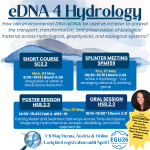
In 2023, I wrote a small request to the Swiss National Science Foundation to lead a workshop to bring together hydrologists and biologists and explore how eDNA was being used and could be used in our respective fields [1].
Environmental DNA is the genetic material that can be extracted from environmental samples, in this case we are mostly talking about stream and river water. If we sequence this genetic material, we can glimpse all the organisms that have shed material into the water upstream of where we collect it.
When water flows through a landscape, whether through soil, bedrock, meadows, it picks up traces of all the organisms that have left material there, whether leaves, fish scales, bacterial cells, or algae. Eventually the eDNA degrades by radiation or bacteria. In the last few decades this “library” of information has been tapped by biologists to understand biodiversity in a way that avoids many of the previous limitations of species inventories and observations, even if it introduces new challenges and biases. The choice of how the sample is taken, treated, and sequenced determines what kind of organisms, bacteria, fungi, viruses, vertebrates, etc., will be identified and at what resolution.
I first heard about environmental DNA a few years earlier, and upon reading my first paper about it, my eyes lit up. As a hydrologist trying to figure out where water was coming from and how fast, this might be just the tracer I was looking for. On one hand, this genetic material was so much data. As a hydrologist, I was always mainly focused on 2 variables – δ18O, and δ2H. With our new isotope instrument, I got δ17O as an easy bonus, but no one was quite sure yet what it could tell us. If I carried a little more equipment in the field, I could get temperature and electrical conductivity. When I installed some probes, maybe turbidity and dissolved oxygen. With a little extra lab work, I would round it out with total ions and cations. And with our biggest probe, and EXO2, then I could additionally measure nitrate, pH, turbidity, Temperature, Conductivity, DO, fDOM, Ammonium, and Chloride. So all together that is on the order of 25 variables? eDNA must be what 10’000? 100k?
On the other hand, none of these biology papers seemed to think about all the things that I was obsessed with – should you sample eDNA in low flow conditions? High flow conditions? Will it tell you the same biodiversity facts? How could it be totally separate from flow? Could this one sample really be this standardized biodiversity read out? Obviously turbulent conditions will be different than laminar flow? If it just rained, the water will be full of other organisms. This same flow that gave rivers this super power to read up stream, also means that they are difficult to track, right? Why did no one ask us?
So in 2023, we all got to gether to debate these issues, and wrote a whole paper about it.
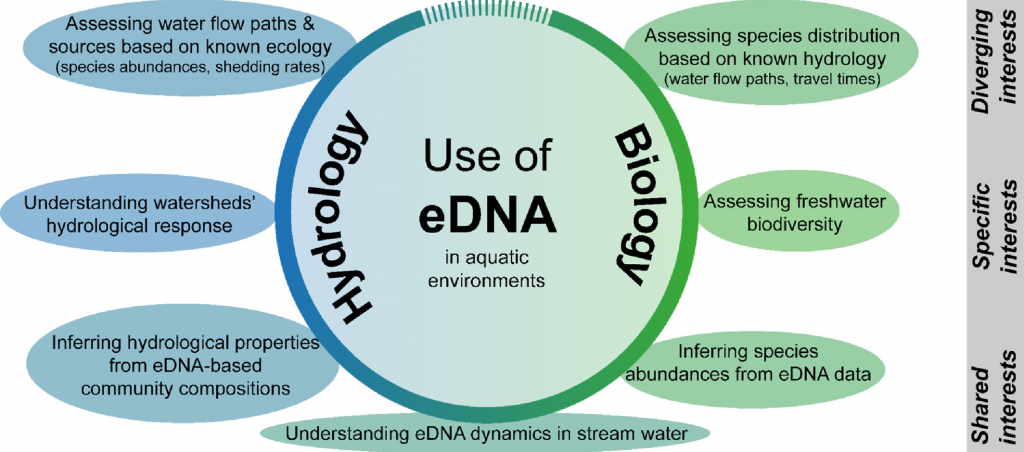
Our main conclusion is that both fields – biologists using eDNA and eDNA-curious hydrologists – need each other more than they thought. Biologists surveying freshwater biodiversity should think about whether current flow conditions are dominated by groundwater or recent rainfall runoff. Similarly, hydrologists might be onto a powerful new tracer. These biological communities in rivers and streams are sensitive to their environment, the microbes, for example will be entirely different if the water that has spent months percolating through deep soil or if it just rushed over the surface after a heavy storm.
In our paper, we present a few of the projects the various attendees of the workshop had completed at this interdisciplinary intersection. For example, in headwater streams in Oregon, researchers found that differences in microbial community composition between catchments closely tracked differences in climate and landscape features, suggesting that an eDNA fingerprint. In an alpine catchment in Switzerland, a single set of eDNA samples could track the alternation of spring vs. tributary water within a single catchment. We showcase models of species distributionsacross an entire river network based on eDNA measurements coupled with flow patterns and observations of how a rainfall even shifts the microbial community, suggesting a change in water source at a different time scale than that revealed by other tracers.
Our paper tries to distill the respective fields for each other by suggesting sets of parameters and metadata that would complement the eDNA to think more about flow patterns or more about community ecology or habitat, respectively. Additionally simple metrics from the respective fields that may be useful to explain observations. For example, metrics like the baseflow index, which describes how much of a river’s flow comes from groundwater, or transit time distributions, which describe how long it takes water to arrive at a catchment outlet. On the other hand, it tries to break down the choice between targeting a single species with highly sensitive genetic tests (qPCR) versus sweeping surveys of entire biological communities (metabarcoding); the importance of sampling replicates; the need for careful contamination controls; and the challenges of matching biological sequences to reference databases that are still incomplete for many organisms.
Regardless, it is clear that the time is now for interdisciplinary collaboration. Freshwater biodiversity is declining faster than almost any other ecosystem on Earth. At the same time, water security , the reliable availability of clean water , is under increasing pressure from climate change and human demand. These two crises are deeply connected. Rivers link landscapes, species, and water supplies in ways that no single discipline fully captures.
Environmental DNA bay be the bridge. Because it reflects both the biology and the hydrology of a river simultaneously, it offers a rare opportunity for scientists who have traditionally worked in separate silos to collaborate on shared questions. Where does this water come from? What lives in it? How is the watershed responding to a changing climate?
To succeed, we need open data sharing, and for the development of a common scientific language between ecologists and hydrologists. The rivers have been recording their own stories all along. We’re only just learning how to read them.
[1]Funding Acknowledgement: Scientific Exchanges Fund: https://data.snf.ch/grants/grant/220742