Environmental DNA is emerging as a powerful tracer for understanding how biological material moves through our planet’s water systems. Here’s everything you need to catch at EGU26.
What if a water sample could tell you not just what organisms live there, but how sediment travels, how catchments connect, and how ecosystems respond to change over time? That’s the promise of environmental DNA (eDNA) as a hydrological tracer — and EGU26 is bringing the community together to explore it in depth.
Four ways to engage with eDNA 4 Hydrology
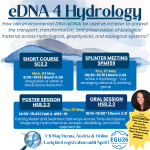
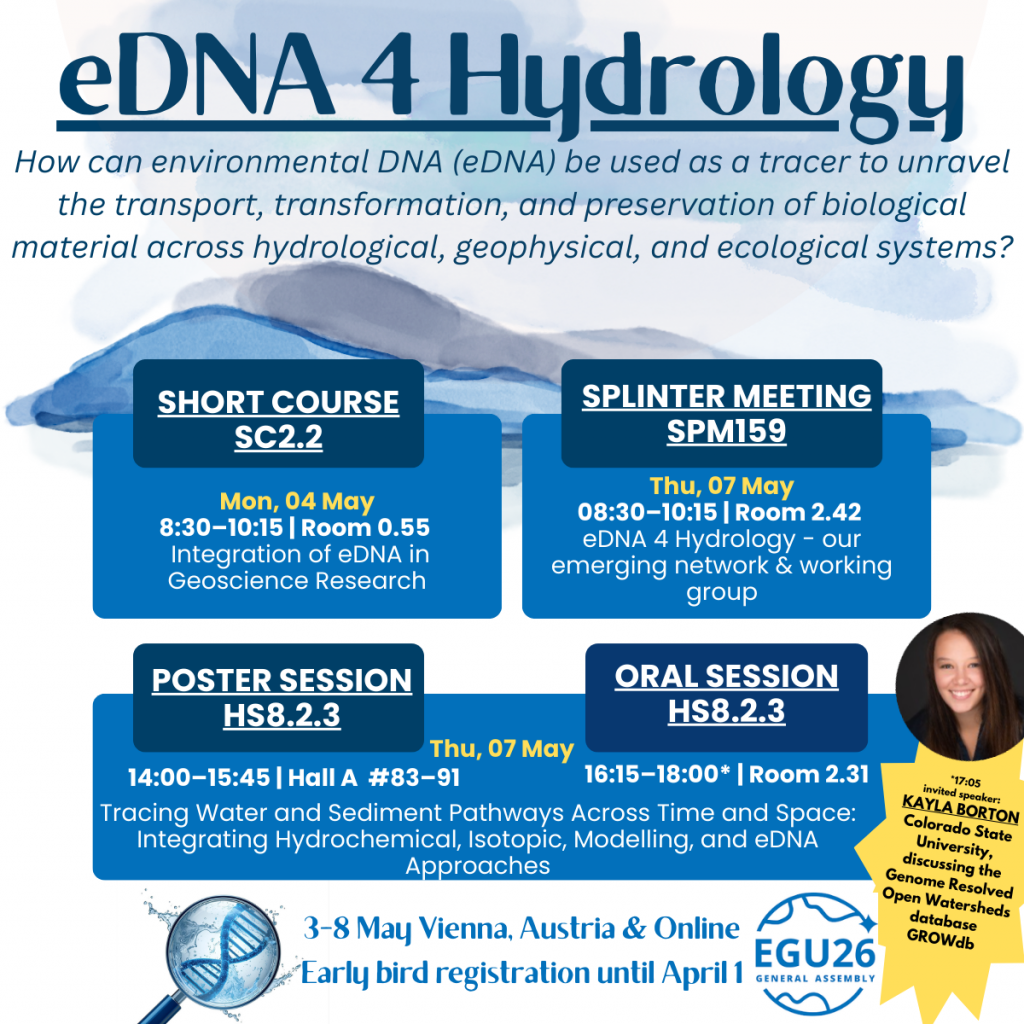
1. SHORT COURSE · SC2.2
Integration of eDNA in Geoscience Research
Mon 04 May · 8:30–10:15 · Room 0.55
A hands-on introduction for geoscientists looking to bring eDNA methods into their work. Perfect for early-career researchers.
2. SPLINTER MEETING · SPM159
eDNA 4 Hydrology — our emerging network & working group
Thu 07 May · 8:30–10:15 · Room 2.42
Meet the growing international network, shape the working group’s agenda, and connect with collaborators across disciplines.
3. POSTER SESSION · HS8.2.3
Tracing Water and Sediment Pathways Across Time and Space
Thu 07 May · 14:00–15:45 · Hall A, #83–91
Integrating hydrochemical, isotopic, modelling, and eDNA approaches — browse nine poster contributions side by side.
4. ORAL SESSION · HS8.2.3
Tracing Water and Sediment Pathways Across Time and Space
Thu 07 May · 16:15–18:00 · Room 2.31
We have a block of talks focused on eDNA starting with our invited speaker at 17:05,
Kayla Borton · Colorado State University
Speaking at 17:05 in the oral session, Kayla will discuss the Genome Resolved Open Watersheds database (GROWdb) — a landmark resource connecting genomic data to watershed science.
Why this matters right now
eDNA research is at an inflection point. The technology has matured beyond proof-of-concept, and hydrologists are increasingly asking: how does genetic material actually move through a catchment? How is it transformed, preserved, or lost as it travels from hillslope to estuary? The sessions at EGU26 tackle these questions head-on, bringing together isotope geochemists, modellers, ecologists, and molecular biologists who rarely share the same room.
The eDNA 4 Hydrology working group is still forming — which means EGU26 is a rare chance to get in early, shape the research agenda, and build collaborations before the field crystallises. Whether you’re an eDNA specialist curious about geophysical transport, or a hydrologist wanting to add a biological dimension to your tracer toolkit, there’s a session designed for you.